Shearing
Services Home
Wool Assessment
Web Design
and Updating
Handspinning Info
Small sheep farms often have a difficult time getting shearers. Zack began shearing our own sheep, then started getting calls from other shepherds in the area. He does NOT shear anymore. A sort of pictorial essay is below.
Important: Please schedule your flock well in advance of shearing season (typically April, as May is a busy time here). And do, please, have your sheep shorn in the spring. We hear of too many calls from small flock owners in midsummer, whose sheep are gasping in the heat. Do your sheep a favor, get them out of their winter coats early!
Some suggestions when you're getting ready for any shearer to visit your flock:
- Allow at least 20 minutes per sheep for movement, shearing and cleanup.
- Let Shearer know if there will NOT be electricity available. Some are able to blade shear.
- Choose a shearing area that is well lit but out of direct sunlight if possible.
- Make sure your sheep are under a roof the night before shearing. If they are at all wet, they cannot be shorn.
- Don't feed your sheep for 12 hours prior to shearing. They will be much more comfortable in the 'shearing position' if their stomachs aren't full. Don't, however, withhold water.
- Make sure the floor or ground is well swept and away from any source of loose hay or other vegetation. Don't ruin your precious fleece by contamination on shearing day!
- If you have more than a few sheep, make sure you have helpers who can keep the sheep moving to the shearer, helpers to bag, weigh, and record the wool, helpers sweep the shearing tarp between sheep, and if possible, helpers to immediately skirt the fleeces before they're bagged. Make it a fun day and invite all your spinning friends to help out!
- If shearing after lambing, and allowing lambs to stay with mom, have helpers who can keep track of the little ones so they don't get trampled or escape to the outside.
- As a courtesy to the shearer, do offer hot or cold beverages regularly. Heatstroke on a hot day is a real possibility as shearing is back-breaking work.
If you have any other questions, don't hesitate to ask your shearer! We were new to shepherding once, and understand that new shepherds might not know all they need to for a smooth shearing day and always learning new things.
Shearing Day
Shearing is a spring routine on a sheep farm. It can be difficult for a small sheep farm to find a shearer willing to visit the farm, so Zack decided to give it a whirl. He bought some used shears, took a couple of classes, and now shears our flock and small flocks for other shepherds in the area. Shearing is truly backbreaking work for the shearer, and hard on the animals, too. In particular, Shetlands are wirey and feisty. They don't like to be sat on their rears with noisy, vibrating machines run over their bodies! And because they're smaller than standard sheep, they don't fit well in the usual sheep shearing holds--although horns on rams and some ewes make them a bit easier to manage. But when the wool is off, they do seem grateful to be rid of their heavy winter coats! Since we sell our wool to handspinners, it is important to us to make sure it's top quality. We feed our animals in a way that minimizes hay in their wool, and we don't bed them down on hay, straw, or anything else that could contaminate the wool. We shear before lambing to keep the wool as clean as possible, and to help the babies find their moms' teats after they're born. We then skirt the wool heavily to remove whatever vegetable matter did get in the wool, and other trash like manure tags. This assures that our wool, when processed into roving, will have as little junk as possible. It's a delight to spin! |
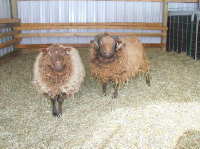 |
| William and Timothy (with horns) don't know what they're in for today! |
|
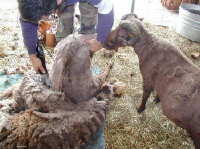 | |
| Timothy assures his brother that he'll live through shearing. | |
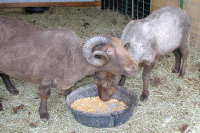 | |
| The boys enjoy a well- earned snack. Note how different their colors are. |
| Site Map | Back to Top | Contact Us | Feedback |